Cox Communications · 2006 to 2015
Reinventing the cable TV experience
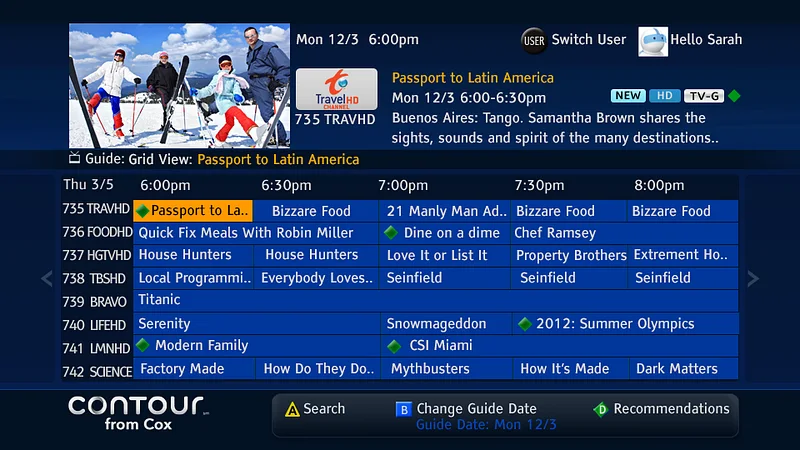
I designed the guide, DVR, and on-demand experience for four million Cox subscribers, and the navigation model underneath it.
- Company
- Cox Communications
- My role
- Sole UX designer and product manager
- Scope
- Guide, DVR, VOD, and interactive TV
- Years
- 2006 to 2015
- Reading time
- 2 minutes
By 2006, TV was at a turning point. DVR, video on demand, and internet video were giving people control the old cable interface could not match. Channel counts had grown from dozens to over a thousand, and the grid guide had not changed since the 1990s.
Cox hired me as the sole UX designer and product manager to architect, design, prototype, test, and help launch the next-generation experience across the interactive program guide, video on demand, DVR, and interactive TV applications.
The problem
Sitting down to watch TV in 2005 meant flipping through hundreds of channels, digging through nested menus for recordings, and ordering a movie through a maze of screens. One customer told us, "I feel like I need a PhD to watch Friends."
People were frustrated, and they were tuning out.
What I did
1. Study how people actually watch
I ran in-home ethnographic research with families, teens, seniors, and power users, and led workshops with engineering, marketing, product, and executives. We set a north star of simple, predictable, delightful, and fast, then turned it into principles we called SCIN: simple, consistent, intuitive navigation.
2. Design a new mental model
To untangle the complexity, I designed a navigation model built around a redwood tree:
- The trunk: the home menu, the anchor
- Branches: major destinations such as guide, DVR, movies, and on demand
- Twigs: subsections such as recordings, recommendations, and recently watched
- Leaves: final actions such as play, record, save, and delete
The goal was three clicks to anywhere, fast, predictable, and friendly to a simple remote.
3. Build the system, not just the screens
I authored the full UI specification, covering interaction logic, focus states, remote rules, error states, color and type, and grid layouts. I also wrote a style guide and built a reusable component library that was a precursor to modern design systems. One rule stuck: no dead ends, and every turn has a clear way out.
I prototyped and tested across three Cox markets, and each round of findings went back into the system.
What changed
The new experience launched to four million Cox subscribers. It produced dozens of utility and design patents for navigation architecture, DVR workflows, guide displays, and UI interactions, and earned a Technology & Engineering Emmy Award nomination.
It also drove greater DVR engagement, higher on-demand conversion, less customer frustration, and lower support call volume.
What I'd do differently
I would have documented the design system more rigorously. The component library made new features dramatically faster, but stricter contribution rules would have kept it consistent as more teams touched it. I have carried that lesson into every design system since.