The Coca-Cola Company · 2025 to 2026
myCoke Voice of the Customer: feedback that reaches the roadmap
Customer feedback was scattered across channels and rarely reached the roadmap. I built the system that changed that.
- Company
- The Coca-Cola Company
- My role
- Director, B2B Product Design
- Scope
- Built the program end to end
- Years
- 2025 to 2026
- Reading time
- 2 minutes
As Director of B2B Product Design, I built and launched the myCoke Voice of the Customer (VoC) program. The goal was to make continuous customer insight a normal input to product decisions instead of a one-off study.
The problem
Feedback lived in support tickets, sales notes, and operations, and rarely became product action. Each team used different research methods. Analytics showed what happened but not why, so prioritization ran on anecdote.
The organization needed a system that paired quantitative signal with qualitative depth, and a reliable way to move insight into the roadmap.
What I built
1. One connected insight system
I designed VoC as a single system, not a pile of surveys. It draws on four kinds of input:
- Quantitative: NPS, CSAT, CES, web analytics, and in-product feedback
- Strategic: a customer council and key-account feedback
- Qualitative: usability testing, contextual interviews, and field observation
- Behavioral: friction detection in tools like FullStory
An early example: rage-click heatmaps exposed checkout friction, and a targeted redesign improved completion and reduced support volume.
2. Make insight drive action
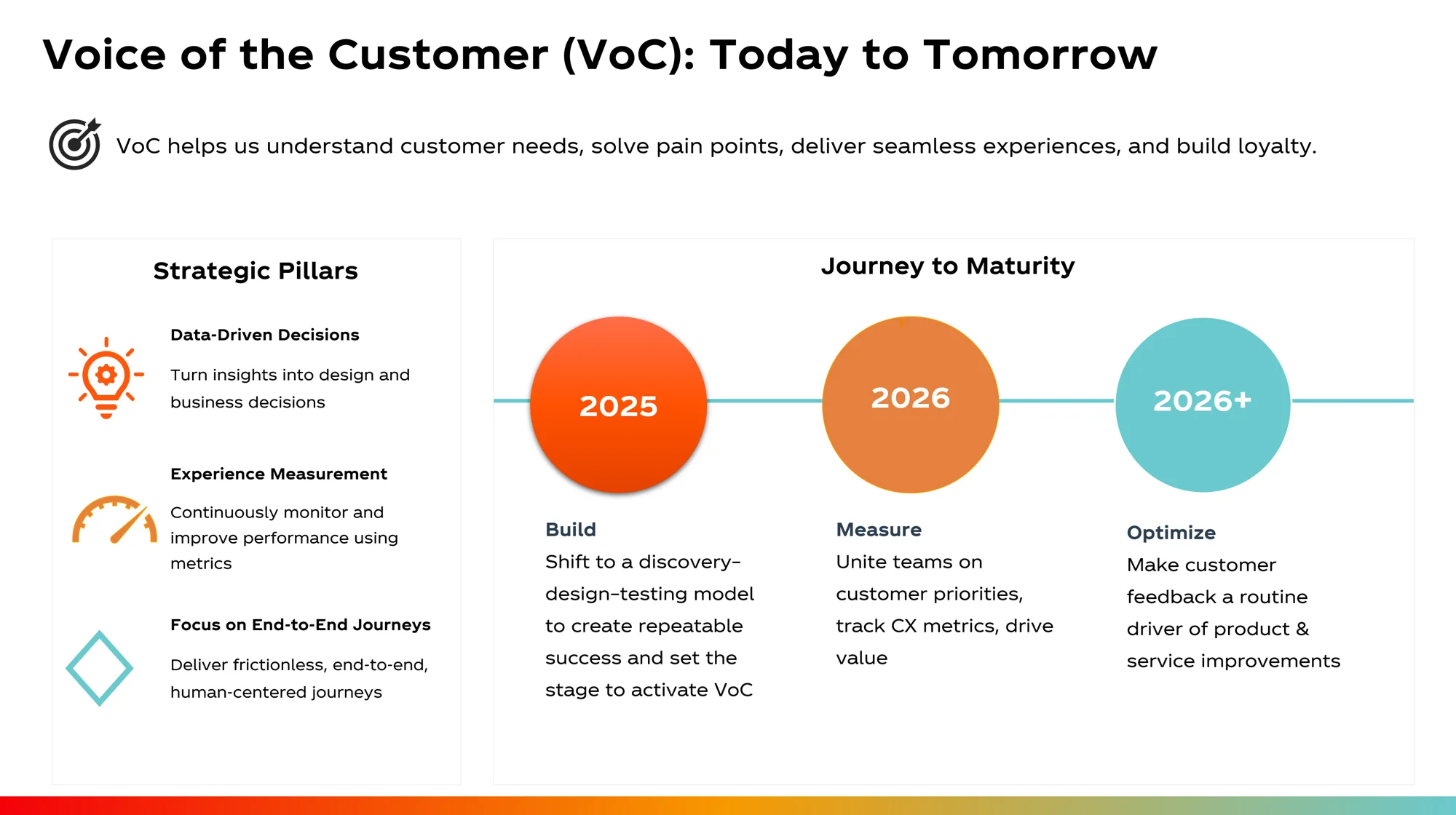
The program runs on three steps: listen, understand, act.
- Listen: continuous signal collection
- Understand: cross-method synthesis and root-cause analysis
- Act: direct translation into roadmap and experience improvements
3. Roll it out in three phases
- Phase 1, foundational understanding: contextual research, call listening, field observation, journey mapping
- Phase 2, signal centralization: NPS and in-product feedback, analytics integration, one insight repository
- Phase 3, continuous optimization: quarterly usability deep dives, bi-annual NPS cycles, ongoing customer panels, monthly insight-to-roadmap reviews
What changed
Order management. Structured discovery with EDI customers surfaced last-minute order changes as a major friction point. The new design reached 100% completion of order changes in usability testing and shaped features for modifiable orders, clearer product swaps, and instant confirmation.
Customer interviews. Insights moved order cutoff times, email notifications, and accurate product images and templates up the roadmap.
Service operations. Call listening with independent service providers surfaced a need for better shipment visibility, clearer pricing, and accurate inventory. That led to more transparent parts detail, upfront pricing, and faster returns and approvals.
These insights shaped the myCoke platform transformation, from ordering and service workflows to the parts experience and self-service.
Across the organization, teams now share one view of the customer, use a repeatable discovery-to-validation model, and lean on evidence over opinion.
What I'd do differently
I would share ownership sooner. Building the program end to end got it moving fast, but it also meant it leaned on me. Next time I would name a Product partner for each phase from the start, so the monthly insight-to-roadmap review belongs to Product as much as it does to Design.